
India's growth, he said, remains resilient with low inflation, fiscal prudence and low current account deficit, talking about robust structural reform measures.

The opposition made it clear during the meeting that it will press for a joint parliamentary committee to probe the Rafale jet deal and raise several issues, including the "misuse" of probe agencies and the autonomy for Reserve Bank of India.

Be it bad loans resolution or his uncanny focus on inflation fighting which earned him criticism of being a policy hawk, Acharya was at the centre of it all and deftly steered the policy machinery.

'The RBI is something like a seat belt. As a driver, the driver being the government, it has the possibility of not putting on a seat belt but of course if you do not put on your seat belt you get into an accident and the accident can be quite severe,' Raghuram Rajan told CNBC TV18. 'The aim of the board is to be Rahul Dravid -- sensible, thoughtful and not, with due respect, Navjot Sidhu,' he added.
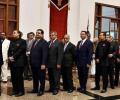
Of the 40 CEOs polled from across the country, 60 per cent identified a fractured electoral mandate as a bigger risk than trade wars, volatile oil prices, and inflation.

'We feel there is definitely something murky in the system.' 'Will anyone believe that Nirav Modi will go to a branch and bribe a low-level officer?' 'Just look at the people with whom he had moved around.'
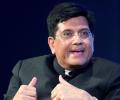
Piyush Goyal, who held the post of finance minister when Arun Jaitley was undergoing treatment, told the Confederation of Indian Industry's annual session: "All stakeholders, including the RBI, should introspect on their respective roles (on low economic growth)."
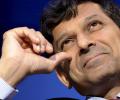
'The RBI risks becoming dangerously weakened, as successive governments and finance ministers have misunderstood its role'.
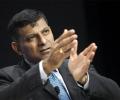
Rajan, as expected, furthered his predecessors' agenda and continued with the same resolution to make India's financial system safer, and direct the economy towards further liberalisation
Today, with growth having slowed and macro-economic challenges in every direction, would the government have benefited from the advice of 'Harvard' economists? asks T N Ninan.
T C A Srinivasa-Raghavan recalls a tussle between the government and RBI when Rajiv Gandhi was prime minister and how it was resolved.

A three-year validity of an inflation target is, perhaps, more reasonable and practicable.

'People always short-change the resilience of the economy.'
'Those who come from outside are surprised at the relatively small strength of the RBI supervisory cadre, relative to the needs of the country and the needs of the financial sector.'

'The Jalan Committee has now provided very clear guidelines on how the (RBI's) balance sheet should be looked at, what kind of disclosures should be made, what are the principles on which the Contingency Risk Buffer should be maintained, what should be the revaluation reserves, and the market risk to the Contingency Risk Buffer.'
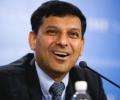
Reserve Bank of India (RBI) Governor Raghuram Rajan spoke on a host of issues at his last post-policy interaction with the media

To do so, the government will have to tackle a number of broad development challenges successfully, says Shankar Acharya
RBI conducts interviews for first lateral hire for CGM post; deputy governors to head four distinct verticals.

Angry Congress members staged a walkout during Modi's address.

Government looking at cushioning slowdown due to demonetisation with sops and higher outlay for micro, small and medium enterprises, agriculture, and affordable housing.
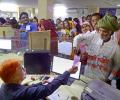
James Wilson tracks down discrepancies in the much-hailed demonetisation policy and the subsequent statements of the government and the Reserve Bank of India.
Hopefully, the grey world of central banking in a nation hit by demonetisation, will lighten up with some of his notes soon.
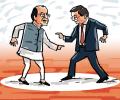
'Has the time come to devise Version 2 of ad hoc T-bills?' 'In return, the government must agree to privatise all but five or six banks.' 'If something like this is not done, we will have governments going on the rampage, with increasing frequency,' says T C A Srinivasa Raghavan.

The unity by the opposition parties is likely to reflect inside Parliament as well.

The Urjit Patel committee on monetary policy framework has proposed setting up of a monetary policy committee (MPC) that will be headed by the Reserve Bank of India (RBI) governor and accountable for achieving inflation target set by it.
'Only the coming years will tell whether the government finds this an easy way of relieving itself from its fiscal constraints.'

That's all it takes to protect an institution -- just one person with no past and no greed for the future, says Shekhar Gupta.

'When I came here in 2002, I said you can grow at 8%.' 'And I was told that was crazy, and (now) here we are.'
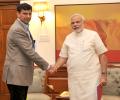
The government's critics say that the Prime Minister failed to rein in vicious and unprecedented personal attacks on the central bank chief by the likes of Rajya Sabha MP Subramanian Swamy.

Although this may not be music to Raghuram Rajan and Viral Acharya's ears, the real reason in my estimation for their quitting is expatriate over-sensitivity, intolerance or arrogance, argues B S Raghavan, the distinguished civil servant.

Delivering a public speech hours after the RBI launched a rescue act for Yes Bank on March 6, Governor Shaktikanta Das reiterated the RBI's affirmation to do whatever was needed to combat the coronavirus impact. On that day, India had only one confirmed COVID-19 infection, the World Health Organisation was five days off from declaring it as a pandemic and the financially debilitating lockdowns were not even on the horizon. Das' promise on efforts to mitigate COVID-19 impact appeared as a footnote in news reports from the event.

'...Unless we muck up our policies.' 'We have to become a modernised economy.' 'Our institutions should be stronger. And that is most important.' 'The rule of law should prevail and contracts should be enforced.' 'Above all, we have to recognise the importance of globalisation.' 'It is in our favour at this stage. We should grow and become globally competitive.'

'The time has come to incorporate Indian sociology into economic policy.' 'The first step in that direction would be to listen to economists trained in India and not just the US and the UK, argues T C A Srinivasa-Raghavan.

'It is like bombing a building with 200 people to kill 5 terrorists.'

This is the first time in the RBI's history that a governor is leaving without willing to renew his contract
If receipts from disinvestment, tax buoyancy and black money scheme offset shortfall in spectrum sale, higher expenditure due to pay commission's recommendations and capital expenditure, then the government would be able to meet the target of controlling fiscal deficit at 3.5 per cent of GDP this financial year.

The RBI governor has to convert the zero-sum game with the government from a non-cooperative one -- which his two predecessors had made it -- to a cooperative one, explains T C A Srinivasa Raghavan.

Adani Mining is building a 300-km rail line for its about $16 billion Carmichael coal mine project in Australia.

Sahil Kapoor of Edelweiss Retail Capital Market Research says that setting up a monetary policy committee should have been the first step. And the central bank could have moved towards a formal inflation targeting mechanism after the processes and data sets are in place.

The 30-share Sensex jumped 729 points to end at 28,076 and the 50-share Nifty soared 217 points to end at 8,494.
 © 2026 Rediff.com - Advertise with us - Disclaimer - Privacy Policy - Sitemap - Feedback - About us - Terms of use - Grievances